


A seismic shift is taking place in Auckland, New Zealand, as Auckland Transport pioneers the integration of open-loop payment systems into the city's public transport network. This innovative move brings the acceptance of credit and debit cards to buses, trains, and ferries, marking a significant stride in the digital transformation of the country's largest city's transportation services. With this advancement, Auckland is set to embrace this technology at least two years ahead of the national ticketing solution's roll out.
Understanding Open-Loop vs. Closed-Loop Payments
Open-loop payment systems are gaining traction for public transit due to their alignment with the modern demand for convenience and universal acceptance. Unlike closed-loop systems, which operate within a confined network and are often limited to specific vendors or services, digital payment systems offer a broader range of payment options. They include multiple payment brands and various mobile wallets, creating a more inclusive and adaptable payment ecosystem.

Benefits of Open-Loop Systems
Enhanced Payment Convenience
Streamline the payment process by allowing passengers to use credit cards, debit cards, and digital wallets, thus accelerating boarding speeds. This flexibility and convenience are key drivers behind the growing trend of open-loop payments in public transit.
Increased Security
By minimizing cash transactions, open-loop payment systems reduce the risks of theft and robbery in public transport operations. Most solutions utilize EMV technology, further enhancing transaction security.
Reduced Operational Costs
Decreases the reliance on ticket machines and sales points, reducing associated personnel and maintenance costs. As passengers increasingly prefer cashless payment methods, operators can save on the operational costs associated with handling cash.
Improved Transparency and Data Analytics
Digitize all contactless payment operations, enabling service providers and users to track transactions, balances, and rates, thereby increasing transaction transparency. This data can be harnessed for big data analysis, supporting customized services and improving operational efficiency.
Scalability and Flexibility
Facilitate integration with new partners and attract more customers, as they accommodate widely used bank cards as payment methods.
Telpo T10 and T20: Embracing the digital Payment Trend
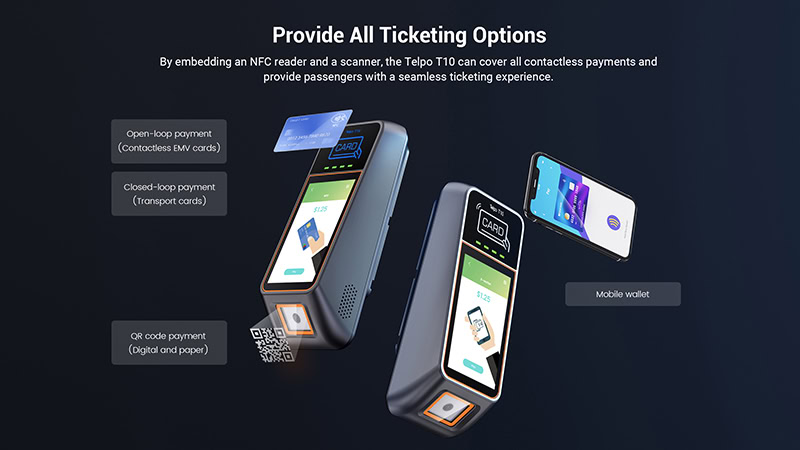
Telpo T10 and Telpo T20 are cutting-edge ticket validators designed to accommodate the growing trend of digital payments in public transit. Both validators support digital payments (contactless EMV cards), closed-loop payments (transport cards), and QR code payments (digital and paper), ensuring they can handle the diverse payment methods becoming increasingly popular in public transit.
Telpo T10: User Experience Highlights
The T10 ticket validator features a 5.5-inch LCD display for clear information presentation and can be installed horizontally or vertically to fit different vehicle layouts. Its high-brightness screen and fluorescent NFC area design make validation easy and quick, even at night, improving passenger convenience and satisfaction.

Telpo T20: Future-Oriented Ticket Validation
The T20 ticket validator offers a robust, powerful, and future-oriented ticket validation solution. Its quick facial recognition and various payment methods provide a fast and convenient validation experience. The dual-band GPS ensures real-time transaction services, and user-friendly signaling, including a high-brightness display and audio cues, further enhances the interactive experience, making the T20 not only efficient but also intuitive and easy to use for passengers.
Ready to revolutionize your public transport system with open-loop payment solutions?
Contact us today to explore how Telpo T10 and T20 can streamline your operations and enhance passenger experiences.
Tags: open-loop payment, Auckland, public transport, payment technology, Telpo ticketing solution